In Italy, craftsmanship isn’t a relic of the past – it remains a living, breathing tribute to Italy’s layered history, rooted in centuries of meticulous skillmanship passed down from one generation to the next.
To mark this year’s celebration of International Women’s Day, taking place on 8th March, we are spotlighting the women upholding Italy’s rich cultural heritage. Through biological winemaking, artisanal cheesemaking and the careful preservation of historic homes, they are defining what it means to protect local craft.
At Tuscany Now & More, our own story is deeply intertwined with this way of being. With over 35 years of experience, we have cultivated close relationships with women who safeguard and celebrate our country’s enduring traditions through the handpicked homes we represent and bespoke experiences we offer.
Keep reading to discover their stories, craft and the experiences that will bring you closer to our Italian way of living.
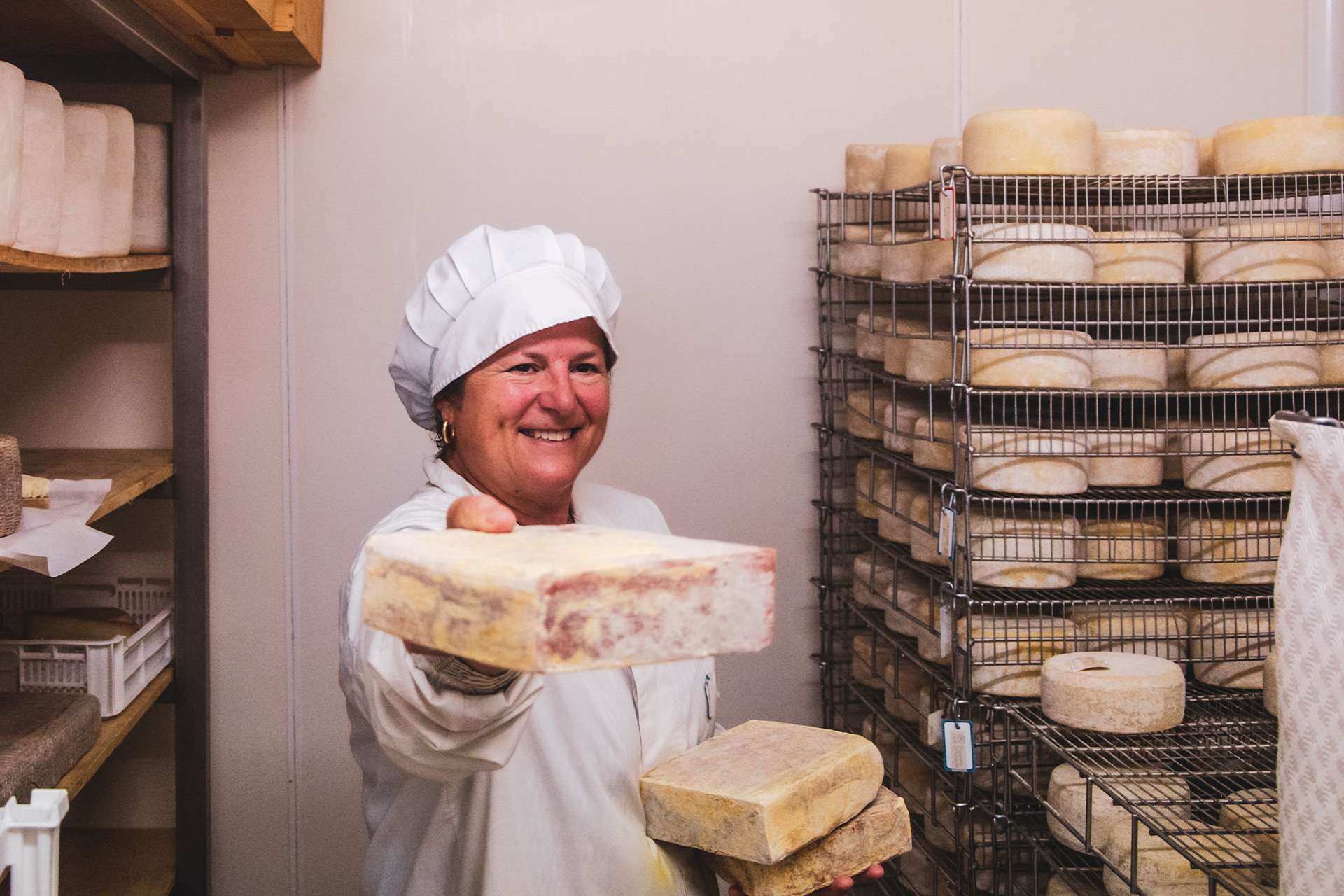
Cheesemaking in the Chianti with Antonia Ballarin
When you feel that it is at its best – ripe and ready to go out into the world, you put on its pretty label and that is a wonderful moment!”
Antonia first arrived at Corzano e Paterno near San Casciano Val di Pesa as a teenager in the 1980s, curious to reconnect with her Italian roots. On the family farm, her uncle had long bred Sardinian sheep before deciding to transform their milk into cheese, a decision that quietly reshaped Antonia’s own path.
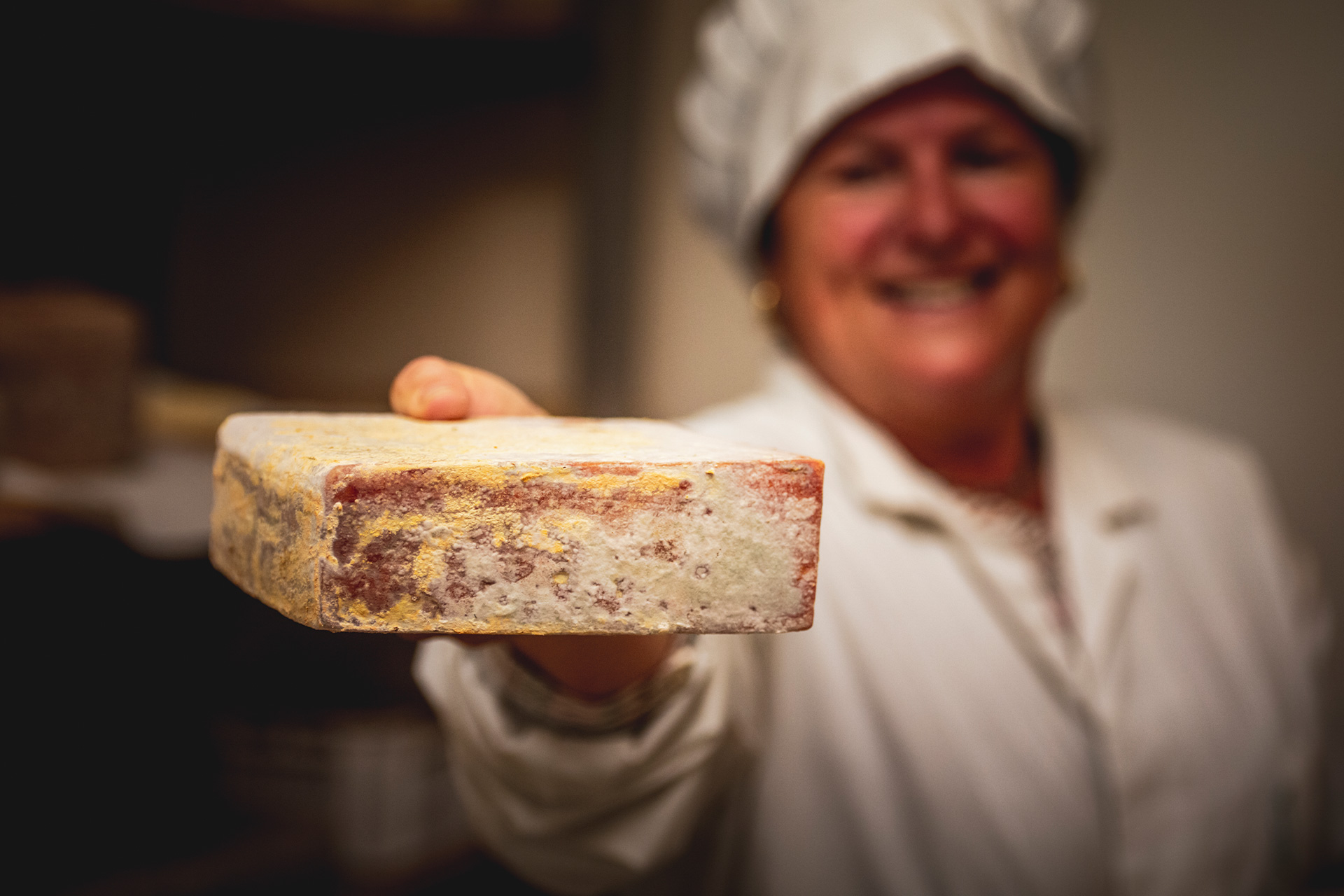
What began as exploration soon became a vocation. Mentored by two local women cheesemakers, Maria and Annunziata, she immersed herself in the rhythms of the dairy, learning to read texture, scent and subtle change. “I cherished the experience of learning from these two remarkable women, full of traditions and knowledge passed through generations”, Atonia reflects.
Today, more than three decades later, the farm produces fourteen different cheeses – many conceived by Antonia herself, whether inspired by varieties she has encountered around the world or born from her own experimentation with the curds. “What still fascinates me, even to this very day, is watching the white, rich milk pour in each morning during the milking season” Antonia muses.
For Antonia, cheesemaking is both physical and intuitive. “You have to be sensitive – pick up the aromas, good and bad – to feel the cheese and let it speak to you” she says. Her favourite moment comes in the quiet of the morning cellar, checking each wheel like “children in a nursery”. Each batch demands something different: turning, washing, salting, patience.
In an era of industrial production, Antonia has witnessed a renewed interest in small-scale farming. Increasingly, she sees young women returning to the land and to smaller family-run businesses where they work the curds by hand. “I think that since Covid, at least in Italy, there has been more of a general feeling and movement toward self-sufficiency.
In these cases, it tends to be young women who are starting up and getting the business going. Rather than immediately moving to the city, many are choosing to stay.”
Her advice? Determination and long hours are to be expected. You have to be curious, artistic, and courageous. And, you must listen to the cheese. “There will be moments of frustration,” she admits, “but they are far outweighed by joy and satisfaction.”
Discover artisanal Chianti cheese
Biological winemaking near Siena with Elisa Tiezzi
“You can definitely see the change. There are more women in technical roles now – more winemakers and entrepreneurs guiding production and making the decisions”
Elisa Tiezzi describes herself first and foremost as a mathematician – a perspective that continues to shape the way she understands the world. She is the owner of Santa Dieci, which is set at the heart of an organic wine estate her family has cultivated since the 1990s, where her husband crafts the wines by hand.
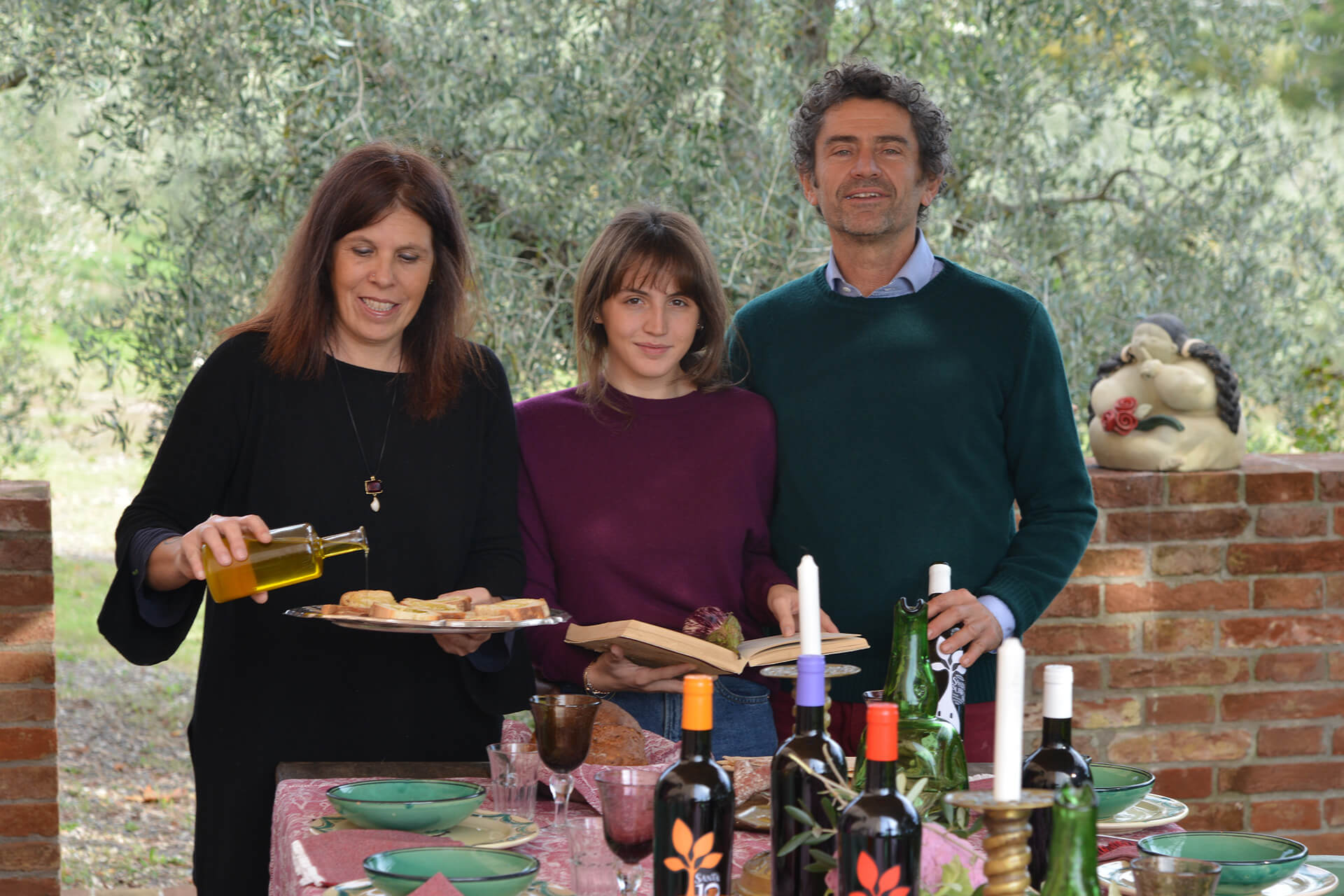
For Elisa, wine is not something static or fixed, but rather the expression of a dynamic system, always evolving and shifting. She describes it aptly as “an ever-evolving interplay of climate, soil, microorganisms and human decisions.”
What matters most to Elisa is a genuine respect for nature’s rhythms and cycles. The term “organic” isn’t simply an adjective to her but a natural process of care and attention, rather than rigidity or control. Though she doesn’t make the wine herself, she describes her role as one of “observing, connecting and shaping that accompanies the physical act of making the wine”.
Her advice for women entering the world of wine puts education first: “Study a lot, and not just oenology. Study systems, economics, ecology, communication, politics, mathematics, biology. And read: poetry, short stories, essays, articles in the field and beyond.”
“Wine is interdisciplinary by nature,” she adds.
As for the future of winemaking, Elisa is placing her faith in the industry’s resilience. “Today we can see new voices emerging, and entirely new ways of speaking. There’s a new “vocabulary” emerging, especially among young winemakers,” Elisa observes. She envisions winemaking that is more diverse, more adaptable and more deeply rooted in local landscapes. But she is wary of trends. “Fads,” she continues, “simplify, accelerate and then ultimately consume – leaving little behind.
“What viticulture truly needs is depth. The future won't be perfect, but it could be more conscious.”
Keeping Italian culture and heritage alive through its homes with Jasmine Boni-Ball
“For me, female leadership isn’t about being louder. It’s about being steady, prepared and collaborative”
For Jasmine Boni-Ball, the concept of home has always been central to her role at Tuscany Now & More. “In Italy, a home is rarely just real estate,” she remarks, “It often stays within the same family for decades, sometimes centuries. These are summer houses, agricultural estates, noble residences, but above all, they hold memory.”
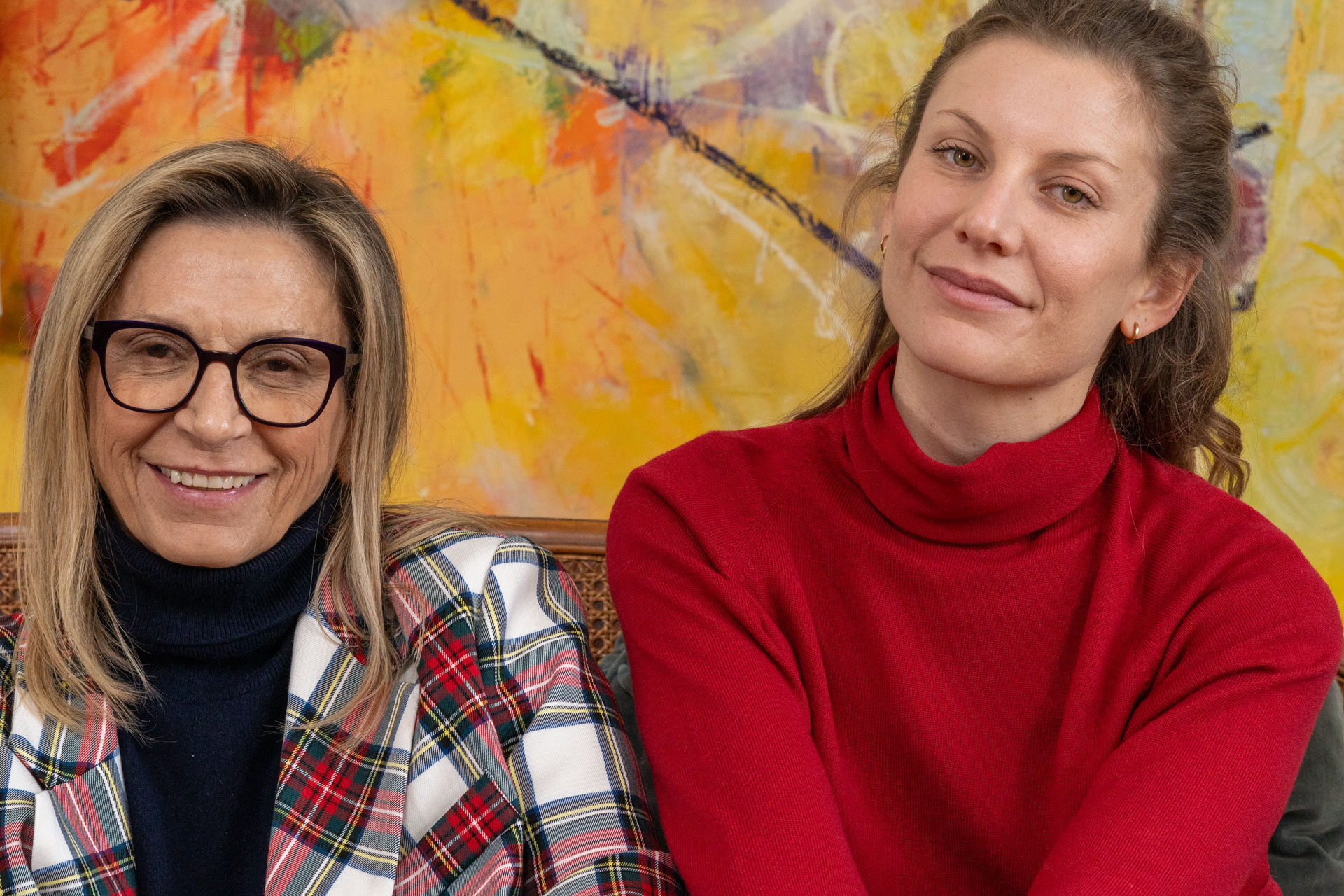
Thanks to her parents, who founded the company over 35 years ago, Jasmine grew up immersed in the world of architecture, design and Italian heritage, developing an early appreciation for how homes carry stories, reflect culture and shape the lives of those who inhabit them.
When asked about her role in keeping Italian heritage alive, she cites restoration as a key element. “Though I didn’t formally study architecture or interior design, I grew up around it,” she explains. “We built many villas ourselves over the years. My father followed projects from beginning to end, working closely with local architects and artisans.”
On the topic of female leaders and collaboration, Jasmine recalls the moment when she joined forces with her mother. “When my father passed away, my mother and I had to step forward together. There was no real pause. We had always worked alongside him, but suddenly we were leading without him. What I learned in that moment was the strength of partnership.”
Strong female leadership in preserving Italy’s heritage doesn’t end there. “Some of the most inspiring collaborations in my work have been with women leading within their own family histories,” she continues. “At Villa Zambonina, for example, the estate has passed through the female line for generations.
In the past, my mother and father worked alongside Marina Cicogna; in the future, it will be her daughter, Matilde, and me. There’s something very powerful about that continuity: women protecting something that outlives them.”
Preserving Veneto’s historic homes with Marina Cicogna
“The advice I would give to a woman interested in restoration architecture or heritage conservation is to arm herself with great patience”
When Marina Cicogna first inherited Villa Zambonina, a place her mother deeply loved, she knew she wanted to conserve it, to honour her mother’s memory. Today, this superb Palladian-style villa sits on the family’s private farming estate just outside of Verona. Inside, vibrant frescoes adorn the walls, nodding to the building’s rich heritage and old-world grandeur.
For Marina, the art of preservation has been a gradual process. “It wasn’t an immediate transformation. I had to integrate this new vision into what had always been a purely private, summer home – a place where my mother used to spend two months every year.”
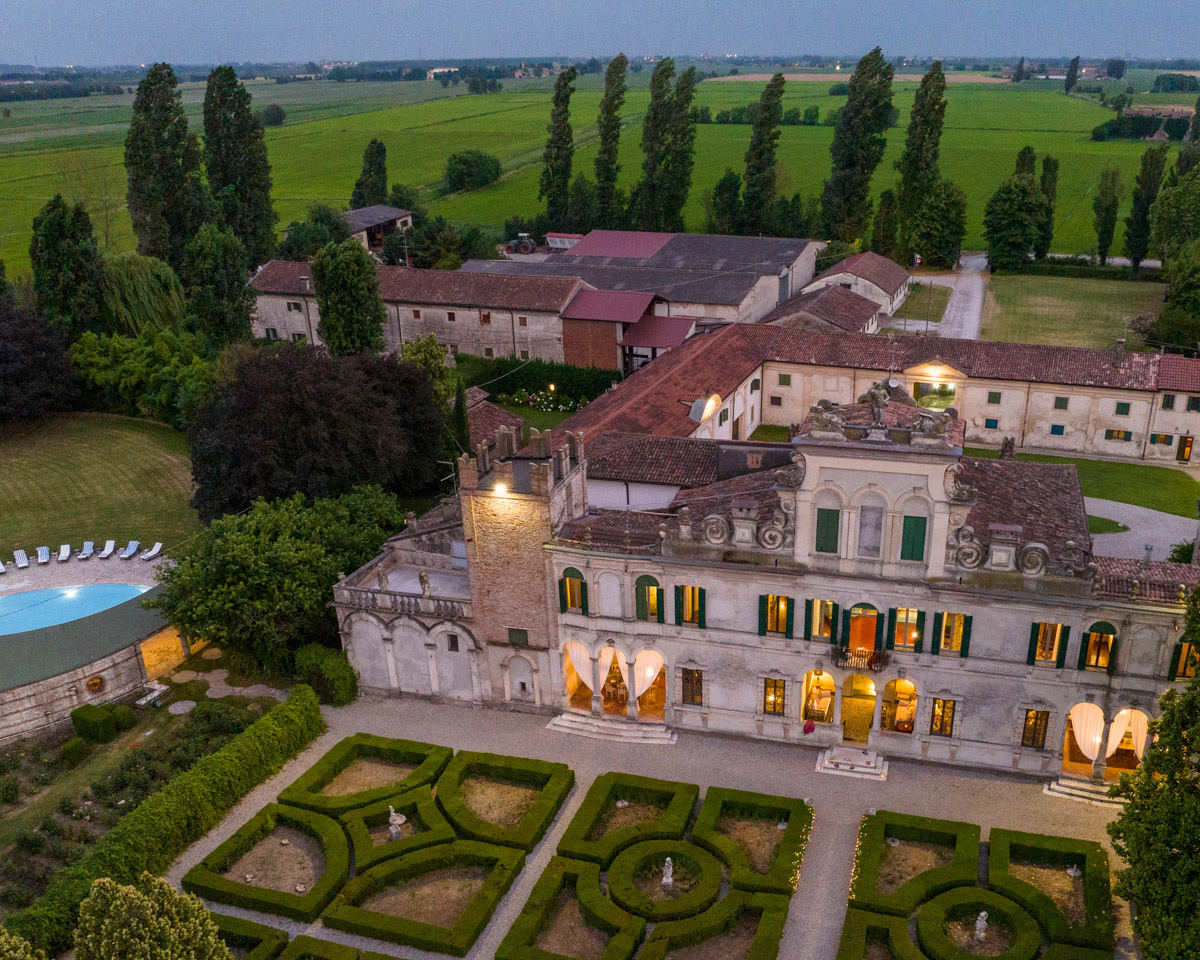
Above all, she wanted to preserve the charm of the property and create a sense of belonging for her guests. “Anyone who comes to stay can truly immerse themselves in a warm, intimate and familiar experience” she tells us.
For women who are interested in pursuing a career in restoration, architecture or heritage conservation, Marina emphasises the importance of patience. “Today, there are fewer and fewer traditional craftsmen, the kind of skilled artisans who were once so common. They are becoming increasingly rare, which makes the search for them more challenging.
Because they are rare, they are also in high demand, and you often have to wait your turn. At the same time, I must emphasise that this is a passion that truly fills your heart. It brings deep satisfaction. But I also believe it can only be done authentically by someone who feels truly connected to a place,” she adds.
“For me, Zambonina represents all of my roots. And just as it was for my mother, I have always seen the women in my life and in my childhood refer to Zambonina as home”.
Marina’s connection to Villa Zambonina is made all the more apparent on the topic of her Italian garden. “I fight constantly to protect this garden,” she admits, “this winter, it was attacked by a fungus that has destroyed many historic gardens across Italy. Fortunately, I noticed it in time and immediately began treating it, thanks also to the support of the University of Padua.”
“I mention this because it may seem like a small detail, but it is not,” she states. This level of vigilance and care reveals Marina’s deep, personal devotion to preserving her home for generations to come. Without such attention, this living heritage could simply disappear.
Safeguarding the art and history of Florence with Elisabetta Cappugi
“I once had the opportunity to travel around Italy on behalf of the Japanese Museum and select some paintings for the exhibition. Botticelli, Tintoretto, Titian… What an honour, what joy, what freedom!”
Elisabetta Cappugi has dedicated her life to the unique craft of preserving Florence’s art and history. Her journey began in her hometown, Florence, where she developed a keen eye and deep passion for art.
This natural affinity led her to pursue studies in art history at university, culminating in a thesis on a fifteenth-century illuminated Divine Comedy created for Filippo Maria Visconti, Duke of Milan. After her studies, Elisabetta pursued a career as a tour guide, a role that allows her to meet new people every day, listen to their stories and share the wonders of art together.
On the topic of women in Florentine history, Elisabetta fondly recalls a conference on women’s art where she had the privilege of speaking. “I highlighted more than 40 remarkable figures,” she reflects, “ranging from the earliest – a nun and scribe who depicted herself in a large initial of a manuscript – to 16th-century painters like Artemisia Gentileschi, and on to contemporary creators such as Vanessa Beecroft, Patti Smith and Marina Abramović. Each of these artists embodies qualities like perseverance, patience, determination and courage,” she adds.
Entering the field of art and history preservation may seem intimidating, and it often comes with certain challenges. For anyone hoping to enter the world of (Florentine) art preservation, Elisabetta explains that passion is paramount.
“But above all”, she says, “listening is perhaps the key word, the most important lesson that has held everything together. I have always been fortunate to be able to listen to those who were more experienced. And then: be kind, respectful of people and the environment and be grateful”.
Art and Cultural Experiences in Florence
Contact our Villa Specialists
Experience Italy’s rich heritage and craftsmanship yourself with a stay in one of our handpicked luxury villas. Our Villa Specialists are here to offer personal guidance and expert insight from the moment you book until the moment you return home.
With the help of our complimentary concierge, there is a vast array of exquisite artisan crafts and local traditions to explore. Enjoy world-class art and architecture, in-villa workshops, intimate tours around artisan ateliers and day trips to the region’s iconic cities – to name a few.